
India will have 30 per cent of its two-wheeler industry turning electric by 2030 as new manufacturers lead the shift, said a report on Monday. Passenger vehicles will be 15 per cent electric and the three-wheeler segment 75 per cent electric by 2030, said the report by BNP Paribas called 'India Autos-Electric vehicles: Minutes to midnight'. "We see FY22 as the year of inflection for the two-wheeler EV industry, with an accelerated EV adoption helped by incentives, wider availability, model launches, rise in crude prices and improved general awareness. We see 30 per cent of the 2W industry turning electric by 2030; the pace of incentive withdrawal presents an upside/downside risk," the report (India Autos - Electric vehicles: Minutes to midnight) said.

'This year there is a sharp spike in fever cases, and it seems to be more than the pre-COVID-19 levels.'

The transition of Class A and Class B medical device makers to the licensing regime by October 1 seems to be an uphill task with several small and medium manufacturers saying they are still awaiting the audit from the government authorities. If the licenses don't come through, either due to lack of audits or MSME units not clearing the audits, then a few thousand small-scale medical device units will face the issue of business continuity in three weeks. Class A medical devices are those with low to moderate risk to the patient or user (surgical dressings for example), while Class B medical devices refer to devices with moderate risks that require special controls (catheters for example).

The Tata group is planning to invest $90 billion in new industries such as mobile components plant, semiconductor, electric vehicles, batteries, renewables energy and e-commerce by 2027. The Tata group's investment in India is far higher than the $75-billion investments planned by Mukesh Ambani-owned Reliance Industries and $55-billion investment planned by the Adani group in the next five years in the country, the Economist reported recently. The investment by the Tata group is a shift in its strategy to focus more in the home markets instead of international markets where the group lost money.

As part of its road map to achieve 100 per cent dependence on renewable energy by 2025, Amazon on Wednesday announced its first utility-scale renewable energy projects in India - three solar farms located in Rajasthan. These include a 210-megawatt (Mw) project to be developed by India-based developer ReNew Power, a 100 Mw project to be developed by local developer Amp Energy India, and a 110 Mw project to be developed by Brookfield Renewable Partners. By the end of 2021, the company had reached 85 per cent renewable energy across its business.

Russian traders have started asking for payments in ruble for their exports to India in a move that could derail trade between the two countries which gathered pace after the war in Europe. This is because Indian importers are unable to pay in ruble. The India-Russia trade gathered pace after Vladimir Putin invaded Ukraine in February this year. In the April-June quarter, India's imports from Russia were valued at $9.27 billion, up 369 per cent year on year.

This would be India's largest crowd-funded programme to help patients with a particular disease.
As many as 34 new drugs were added to and 26 dropped from an updated list of essential medicines on Tuesday, with the government saying this will reduce "patients' out-of-pocket expenditure". The National List of Essential Medicines (NLEM 2022) has 384 drugs, up from 376 in 2015. "Drafting this list is a lengthy process, and around 350 experts from across India have held over 140 consultation meetings to draft the NLEM 2022," Union Health Minister Mansukh Mandaviya said.
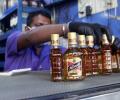
Kerala is likely to witness all-time high liquor sales this Onam, the harvest festival, with the season already reporting a 30 per cent hike. According to the Kerala State Beverages Corporation (BevCo), the first few days of this Onam season have set the tone for record sales. "During last year's Onam season, our sales were around Rs 561 crore. This year, we expect it to be over Rs 700 crore," said Yogesh Gupta, chairman and managing director, BevCo.

Ford India has offered a "final revised severance package" for its employees at the Chennai unit, which is on average equivalent to 130 days of gross wages per completed year of service. The company said this was rolled out in the absence of any suitable alternative buyer. As part of the earlier package, employees were offered 115 days of gross wages for each completed year of service, which was later revised to 124 days.

'Just put a patch on your arm and the vaccine can be absorbed by the body.'
'Gift-giving' - from free dinners and drug samples to promotional merchandise - seems to be driving drugmakers' marketing - a marketing prescription deeply entrenched in the industry. This is a well-oiled racket that sees pharmaceutical (pharma) companies 'gifting' doctors to push their respective drugs under the guise of marketing. But is there a cure in sight to end this unhealthy alliance? The recent controversy following the income-tax raids on Bengaluru-based drugmaker Micro Labs, makers of popular paracetamol brand Dolo-650, has brought this to the fore, again.

On February 24, when Vladimir Putin announced a military operation on Ukraine, few would have thought that Indian government-owned GAIL India would feel the impact. The tensions over gas supplies were essentially a Europe-Russia problem, related to the sanctions western economies imposed on Moscow. But the EU depends on Russian imports for 40 per cent of its gas stocks, an over-dependence that Russia has underlined with Kremlin-owned Gazprom cutting its supplies through the Nord Stream 1 pipeline to 20 per cent, citing maintenance issues.

'The tie-up with Serum Institute Life Sciences brings to the table their strengths in manufacturing and also their vaccine portfolio.'

The average salary received by students during campus placements for 2021-2022 was Rs 21.48 lakh per annum. The highest salary offered was $250,000.
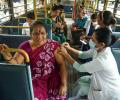
'We are trying to salvage 50-100 million doses of Covishield with the latest drive on booster doses.'

India's plan to produce ethanol from second-generation (2G) sources -- mainly farm waste -- is taking time to materialise even as the government is set to dedicate to the nation on Wednesday a Rs 900-crore plant set up by Indian Oil Corporation (IOC) in Panipat. Though state-run oil companies had decided to set up at least 12 plants in 2016-17 with an investment of around Rs 10,000 crore, this will be the first unit coming on track while others are stuck in various stages owing to issues like capital expenditure, lack of feedstock, and high rates of finished products compared to traditional ethanol units. According to industry sources, three more second-generation plants are coming up.
Bulk of the medicine sales in the $22-24 billion domestic pharma market happens through offline retail chemists. With the entry of online pharmacies, this space has started to witness a shake-up. Sample this: Dawaa Dost, a Rajasthan based digital health start-up, generates medicine orders from 'kirana' stores and women self-help groups (SHGs) that operate in villages, and then service these orders through its affiliated network of pharmacies. Biddano, another health-tech start-up, has a platform that acts as an aggregator for neighbourhood chemist shops.

June was a memorable month for the 101-year-old Tamilnad Mercantile Bank (TMB). Last month, the Thoothukudi-based bank witnessed two new landmarks in a history in which the last three decades could easily qualify for a Kollywood blockbuster.

India's medical devices imports surged 41 per cent to touch Rs 63,200 crore in 2021-22, led by a 48 per cent year-on-year (YoY) jump in imports from China to Rs 13,538 crore, the commerce ministry data analysed by the Association of Indian Medical Device Industry (AiMeD) has showed. Local industry players say this has led to several small and medium units to shut shop. Rakesh Vaid of Usha Fabs, a garments exporter, had started making N95 masks in his Gurgaon factory during the peak of the Covid-19 pandemic.
 © 2026 Rediff.com - Investor Information - Advertise with us - Disclaimer - Privacy Policy - Sitemap - Feedback - About us - Terms of use - Grievances